





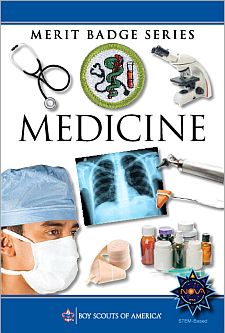

This merit badge wtll be retired on December 31, 2021, and will be replaced with the Health Care Professions merit badge.
Scouts currently working on the Medicine merit badge will be allowed to continue working on it,
but after December 31, 2021, Scouts may not begin working on the superseded Medicine merit badge.
The current Medicine merit badge patch (shown above) will also be used as the Health Care Professions merit badge patch.
- Discuss with your counselor the influence that EIGHT of the following
people or events had on the history of health care:
- Hippocrates
- William Harvey
- Antoine van Leeuwenhoek
- Edward Jenner
- Florence Nightingale
- Louis Pasteur
- Gregor Mendel
- Joseph Lister
- Robert Koch
- Daniel Hale Williams
- Wilhelm Conrad Roentgen
- Marie and Pierre Curie
- Walter Reed
- Karl Landsteiner
- Alexander Fleming
- Charles Richard Drew
- Helen Taussig
- Jonas Salk
- Explain the Hippocratic Oath to your counselor, and compare to the original version to a more modern one. Discuss to whom those subscribing to the original version of the oath owe the greatest allegiance.
- Discuss the health-care provider-patient relationship with your counselor, and the importance of such a relationship in the delivery of quality care to the patient. Describe the role of confidentiality in this relationship.
- Do the following:
- Describe the roles the following people play in the delivery
of health care.
- Allopathic physician (M.D.)and Osteopathic physician (D.O.
- Chiropractor (D.C.)
- Emergency medical technician
- Licensed practical/vocational nurse
- Medical assistant
- Medical laboratory technologist
- Nurse-midwife
- Nurse practitioner
- Occupational therapist
- Optometrist
- Pharmacist
- Physical therapist
- Physician's assistant
- Podiatrist
- Psychologist
- Radiologic technologist
- Registered Nurse
- Respiratory therapist
- Describe the educational and licensing requirements to practice health care in your state for FIVE of the professions in requirement 4a. (Not all professions may exist in your state.).
- Describe the roles the following people play in the delivery
of health care.
-
- Tell what is meant by the term "primary care" with regard to a medical specialty.
- Briefly describe the types of work done by physicians in the
following specialties:
- Internal medicine*
- Family practice*
- Obstetrics/gynecology*
- Pediatrics*
- Psychiatry
- Surgery
- Describe the additional educational requirements for these specialties.
-
- Briefly describe the types of work performed by physicians in
FIVE of the following specialties or subspecialties:
- Allergy/immunology
- Anesthesiology
- Cardiology
- Colorectal surgery
- Critical care medicine (intensive care medicine)
- Dermatology
- Emergency Medicine
- Endocrinology
- Gastroenterology
- Geriatric medicine
- Hematology/oncology
- Hospitalist
- Infectious disease
- Nephrology
- Neuro surgery
- Neurology
- Nuclear medicine
- Ophthalmology
- Orthopedic surgery
- Otolaryngology/head and neck surgery
- Pathology
- Physical medicine and rehabilitation
- Plastic, reconstructive, and maxillofacial surgery.
- Preventive medicine
- Pulmonology
- Radiology
- Rheumatology
- Thoracic/cardiothoracic surgery
- Urology
- Vascular surgery
- Describe the additional educational requirements for the five specialties or subspecialties you chose in 6a.
- Briefly describe the types of work performed by physicians in
FIVE of the following specialties or subspecialties:
-
- Visit a physician's office,** preferably one who delivers "primary care." (This may be that of your counselor.) Discuss the components of a medical history and physical examination (an official BSA health form may be used to guide this discussion), and become familiar with the instruments used.
- Describe the characteristics of a good diagnostic test to screen for disease (e.g. routine blood pressure measurement). Explain briefly why diagnostic tests are not perfect.
- Show how to take a blood pressure reading and a pulse reading.
- Do the following:
- Discuss the roles medical societies, employers, the insurance industry, and the government play in influencing the practice of medicine in the United States.
- Briefly tell how your state monitors the quality of health care within its borders, and how it provides care to those who do not have health insurance.
- Compare and discuss with your counselor at least two types of health care delivery systems used throughout the world.
- Serve as a volunteer at a health-related event or facility in your community (e.g. blood drive, "health fair", blood pressure screening, etc.) approved by your counselor.
* "Primary care" specialties
** If this cannot be arranged, demonstrate to your counselor that you understand the components of a medical history and physical, and discuss the instruments involved.
For requirement 7a you can click on the following
link to get a copy of the New, Simplified Annual Health and Medical Record
The new form has replaced all previous versions and the former Class 1,
2, and 3 Personal Health and Medical Record Forms.
It is designed to be filled in and saved on your local computer and then printed
out on 8 1/2" x 11" sheets.
Click Here to download the Annual Health and Medical Record Form
BSA Advancement ID#:
130
Scoutbook ID#:
747
Requirements last updated in:
2018
Pamphlet Publication Number:
35917
Pamphlet Stock (SKU) Number:
641579
Pamphlet Revision Date:
2012
|
|||||||
Page updated on: May 08, 2022