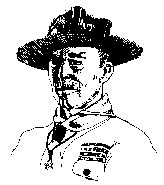
 Lord
Baden-Powell
Lord
Baden-Powell
Excerpt from:
Baden-Powell, The Story of his life
E. Reynolds, Oxford University Press, First printed in 1943.
Mafeking made B.-P. the boys' hero, and it was not surprising that many
wrote to him for advice and help. He took a great deal of trouble to answer
these letters. Here is part of his reply to one from a Boys' Club in London:
"You should not be content with sitting down to defend yourselves against
evil habits, but should also be active in doing good. By 'doing good' I
mean making yourselves useful and doing small kindness' to other people
- whether they are friends or strangers.
It is not a difficult matter, and the best way to set about it is to
make up your mind to do at least one 'good turn' to somebody every day,
and you will soon get into the habit of doing good turns always.
It does not matter how small the 'good turn' may be - even if it is only
to help an old woman across the street, or to say a good word for somebody
who is being badly spoke of. The great thing is to do something."
Letters of this kind set B.-P. thinking of how he could do more to help
boys and how they could best be trained. He had had many years of experience
in training soldiers and, as we have seen, he made some successful experiments.
He found in India, for instance, that scouting was a subject that made a
great appeal and brought out the best in the men. At Mafeking he had watched
and noted the success of the boy cadets who had done fine work when given
the chance and the responsibility. Why not draw up a scheme of training
for all boys on the same lines? Why not train boys as peace scouts, ready
at all times to help others?
The training would have to be attractive and interesting. Here his own
boyhood gave him a clue. He remembered the fun of boating and tramping with
his brothers - the B.-P. Patrol - and the eagerness with which at Charterhouse
he had slipped away into the copse to watch animals and make fires and cook
rabbits. To all this he could now add his own experiences as a practical
pioneer and scout in the army.
On his return from South Africa in 1903 two things helped to point the
way towards the Boy Scouts. First he heard to his surprise that the little
book he wrote for soldiers, 'Aids to Scouting', was being used for the training
of boys in observation. One instance concerned Brigadier-General Allenby
- later Field-Marshal Lord Allenby - and his son. As he rode home after
a field day, the General was surprised to hear a voice call out, "Father,
you are shot. I am in ambush, and you haven't seen me. You should look up."
The General did so, and there was his son lying along the branch of a tree,
and higher up was the boy's governess. It was she who in her work had made
use of B.-P.'s ideas on observation. Then the editor of a boys' paper, 'Boys
of the Empire', had also seen the interest of the book, and had serialized
it under the heading 'The Boy Scout' - probably the first use of the term.
The next important fact was that B.-P. was invited to take the chair
at the annual display given by the Boys' Brigade at the Albert Hall, and
later to review the Brigade in Glasgow. The sight of all these boys, so
smart and keen, made him wish that thousands of others would come along
and be trained in the same way. He talked of this to Sir William Smith,
the Founder of the Brigade; as a result he promised to work out a scheme
of training which could be used by the Brigades to add to the attractiveness
of their work and so bring in more boys.
The chief subject he suggested was scouting, especially training in observation
and deduction. He had no idea of starting a new movement; his aim was to
give some ideas to the Brigade officers to help them in their work. They
did in fact do this, and found that the boys like it. B.-P.'s first suggestions
were published in the 'Brigade Gazette' in 1906, and the following tests
he put down are of great interest.
1. Look into five successive shop windows, one minute at each. Then write
down the contents of, say, the 2nd and 4th from memory.
2. Look at six passers-by and describe from memory, say, the 2nd, 3rd
and 5th, and what you reckon them and their business to be.
3. Remember the numbers of the first two cabs that pass, and presently
write them down from memory.
4. Describe the compass-direction of certain streets, landmarks, etc.,
by the sun; or, if dull weather, 'box the compass'.
5. Read tracks and their meaning - if in the country (or park) send someone
out to make a fairly clear track (using walking stick, etc.). Each boy tracking
for a few minutes in turn, or till he fails.
6. The instructor lays a 'paper chase' (in town or country), not with
paper but with small signs such as buttons, bits of cloth, card, et., all
of one colour, some on the ground, some on bushes, trees, etc., to make
the boys use their eyes. (Objects all of one colour to be used to prevent
confusion with ordinary rubbish.) Boys follow the track, each one being
given the lead in turn for four or five minutes or till he fails.
7. Lay two fires and light them, using two matches only.
8. Cook 1/4 lb. flour and two potatoes without the help of cooking utensils.
9. Draw a sketch of the Union Jack correctly.
10. Scouting race. Instructor stations three individuals or groups, each
group differently clothed as far as possible, and carrying different articles
(such as stick, bundle, paper, etc.), at distances from 300 to 1,200 yards
from starting-point. If there are other people about, these groups might
be told to kneel on one knee, or take some such attitude to distinguish
them from passers-by. He makes out a circular course of three points for
the competitors to run, say, about a quarter mile, with a few jumps if possible.
The competitors start and run to No. 1 point. Here the umpire tells them
the compass direction of the group they have to report on. Each competitor
on seeing this group writes a report showing:
1. How many in the group. 2. How clothed or how distinguishable. 3. Position
as regards any landmark near them. 4. Distance from his own position.
He then runs to the next point and repeats the same on another group,
and so on; and finally he runs with his report to the winning-post."
The more B.-P. thought about this training of boys, the more enthusiastic
he became. He discussed his ideas with all kinds of people, and he watched
how the suggestions worked in those companies of the Boys' Brigade where
they were tried. He was never content to sit by and watch other people,
so he decided to try out the scout training himself with some boys in camp.
He found a site on Brownsea Island in Poole Harbour, and there he pitched
his camp on 25th July, 1907 - a red-letter day for Boy Scouts. The Boys'
Brigade helped him to collect a mixed party of boys. The did not, of course,
wear uniform; some wore trousers and others shorts with collars and ties.
For shoulder-knots they had long twists of coloured wool hanging almost
down to the elbow.
It was not an ideal camp-site, but there was plenty of woodland on the
island for scouting games.
B.-P.'s nephew, Donald, was present as orderly; Major Kenneth Maclaren
- one his fellow-subaltern in the 13th Hussars - cam to help, and Mr. P.W.
Everett there saw Scouting in action for the first time.
The following is B.-P.'s report on the camp:
"The troop of boys was divided up into 'Patrols' of five, the senior
boy in each being Patrol Leader. This organization was the secret of our
success. Each Patrol Leader was given full responsibility for the behaviour
of his patrol at all times, in camp and in the field. The patrol was the
unit of work or play, and each patrol was camped in a separate spot. The
boys were put 'on their honour' to carry out orders. Responsibility and
competitive rivalry were thus at once established, and a good standard of
development was ensured throughout the troop from day to day. The troop
was trained progressively in the subjects of scouting. Every night one patrol
went on duty as night picket - that is, drew rations of flour, meat, vegetables,
tea, etc., and went out to some indicated spot to bivouac for the night.
Each boy had his greatcoat and blankets, cooking-pot and matches. On arrival
at the spot, fires were lit and suppers cooked, after which sentries were
posted and bivouac formed. The picket was scouted by Patrol Leaders of other
patrols and myself, at some time before eleven p.m., after which the sentries
were withdrawn and picket settled down for the night.
" We found the best way of imparting theoretical instruction was to give
it out in short installments with ample illustrative examples when sitting
round the camp-fire or otherwise resting, and with demonstrations in the
practice hour before breakfast. A formal lecture is apt to bore the boys.
"The practice was then carried out in competitions and schemes.
"For example, take one detail of the subject, 'Observation' - namely
tracking.
1. At the camp-fire overnight we would tell the boys some interesting
instance of the value of being able to track.
2. Next morning we would teach them to read tracks by making footmarks
at different places, and showing how to read them and to deduce their meaning.
3. In the afternoon we would have a game, such as 'deer- stalking', in
which one boy went off as the 'deer', with half a dozen tennis balls in
his bag. Twenty minutes later four 'hunters' went off after him, following
his tracks, each armed with a tennis ball. The deer, after going a mile
or two, would hide and endeavor to ambush his hunters, and so get them within
range; each hunter struck with his tennis ball was counted gored to death;
if, on the other hand, the deer was hit by three of their balls he was killed."
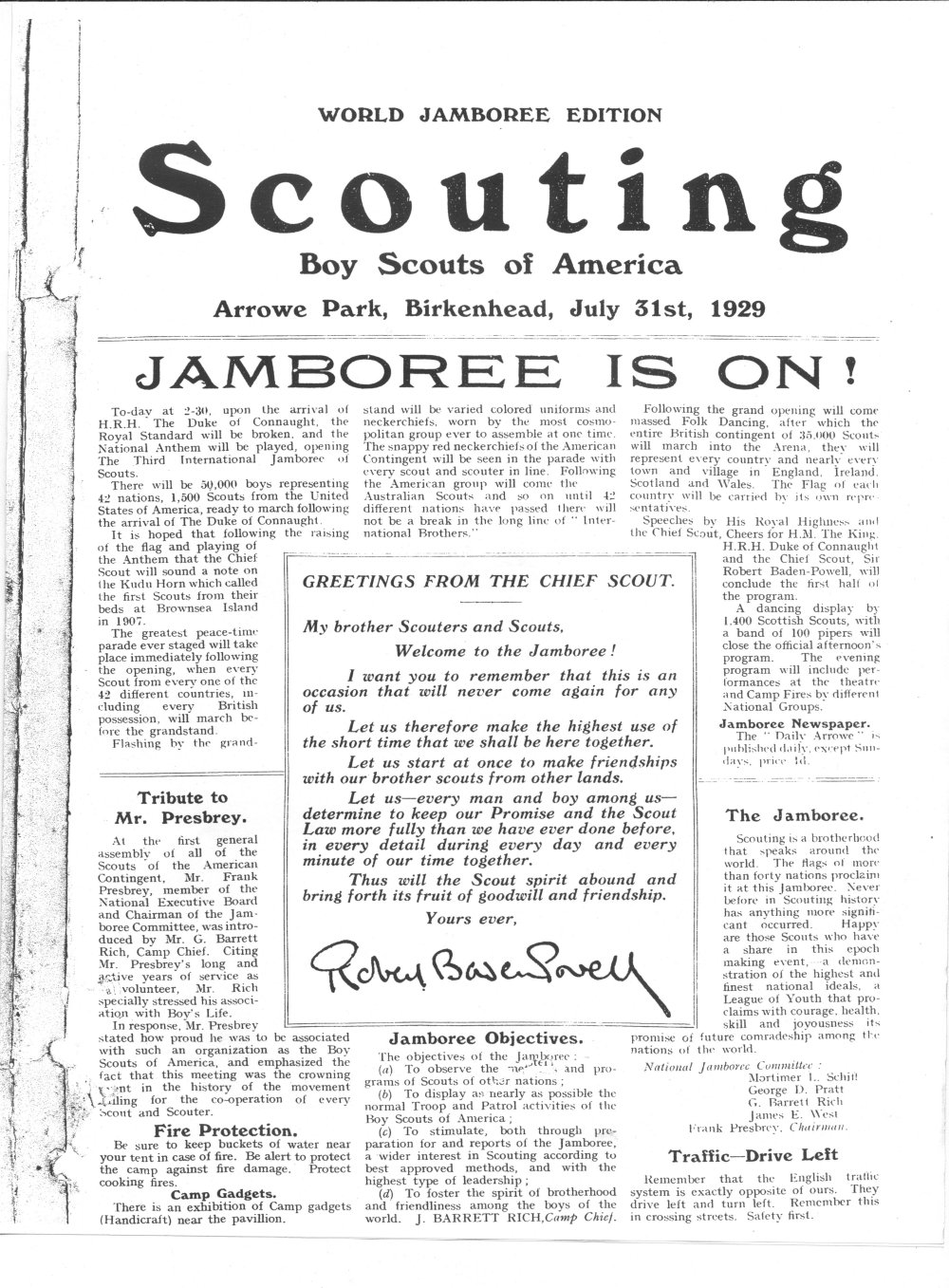
The boys were roused in the mornings by the koodoo horn which B.- P.
had captured in the Matabeleland Campaign.
The camp was not without its amusing incidents. Thus when B.-P. was stalking
a Patrol, he failed to observe one of his own injunctions, "to look up",
and he was captured by his own nephew who had concealed himself up in a
tree. One evening the male members of a house-party which the owner of the
island, Mr. Van Raalte, was entertaining, decided that they would try to
pay the camp a surprise visit. They had not gone far, however, before two
of the boys sprang out from cover and "arrested" them; the prisoners were
marched into camp and had to pay a suitable ransom.
The camp was so encouraging, and the boys so enthusiastic - it was indeed
a thrill to be trained by the defender of Mafeking! - that B.-P. decided
to make the general scheme more widely known. While he was looking about
for means to do this he met Mr. Arthur Pearson, the head of the publishing
firm of that name. He was at once interested, and arranged for B.-P. to
go about the country lecturing to audiences of interested people, and at
the same time to write a handbook for the boys. Mr. Pearson himself undertook
to publish the book, and to start a paper, The Scout, in which B.-P. promised
to write a weekly yarn - this he continued to do for many years, and some
of his best articles on Scouting are to be found in old volumes of The Scout.
In order to be free from interruptions while writing the book, B.-P.
rented a room in the Windmill on Wimbledon Common, London. There he got
down to work to produce one of the most popular boys' books of the century.
Mr. P. W. Everett supervised the publication, and this early close contact
with B.-P. was later to lead to his taking a large part in the growth of
the movement.
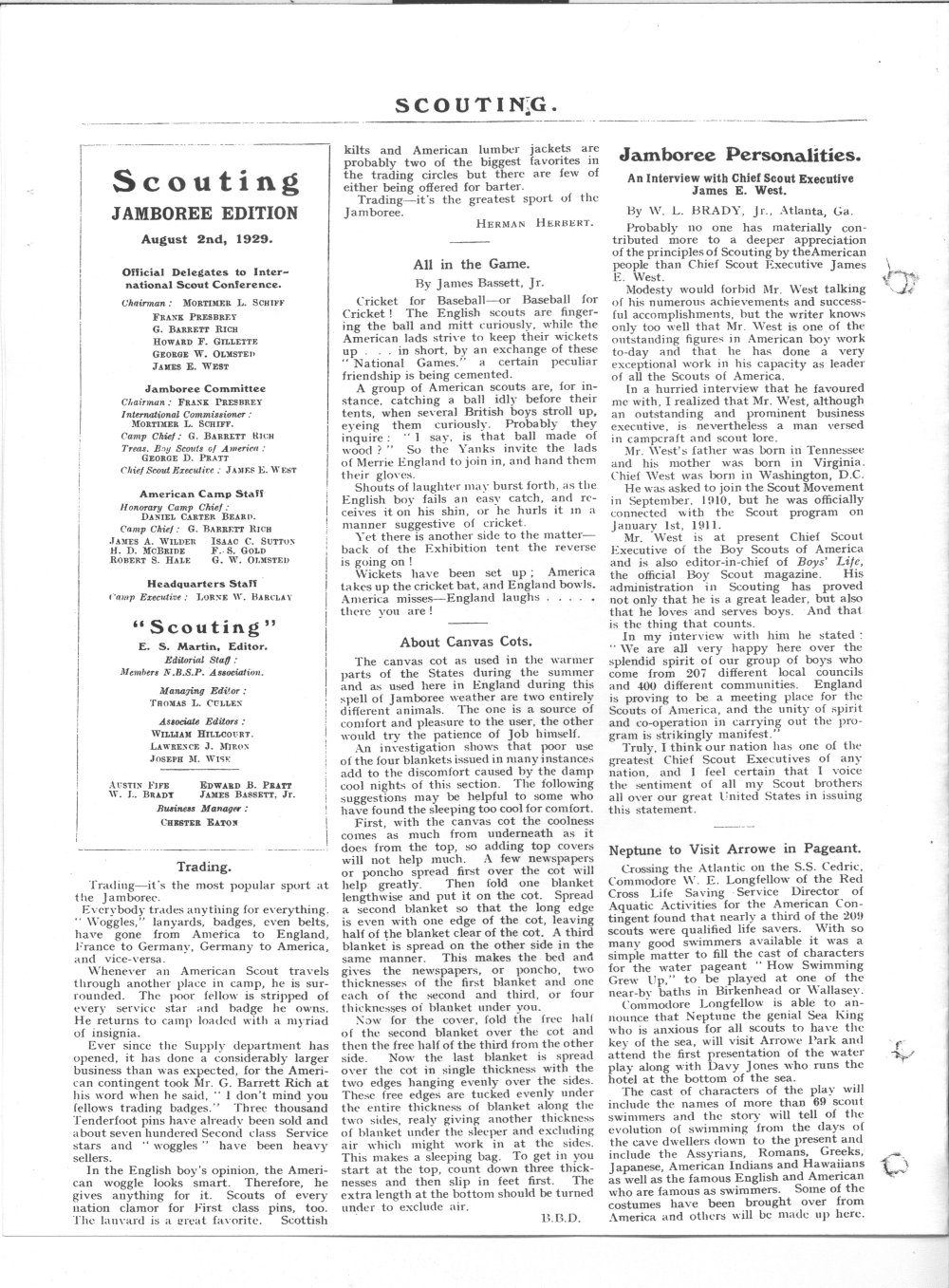
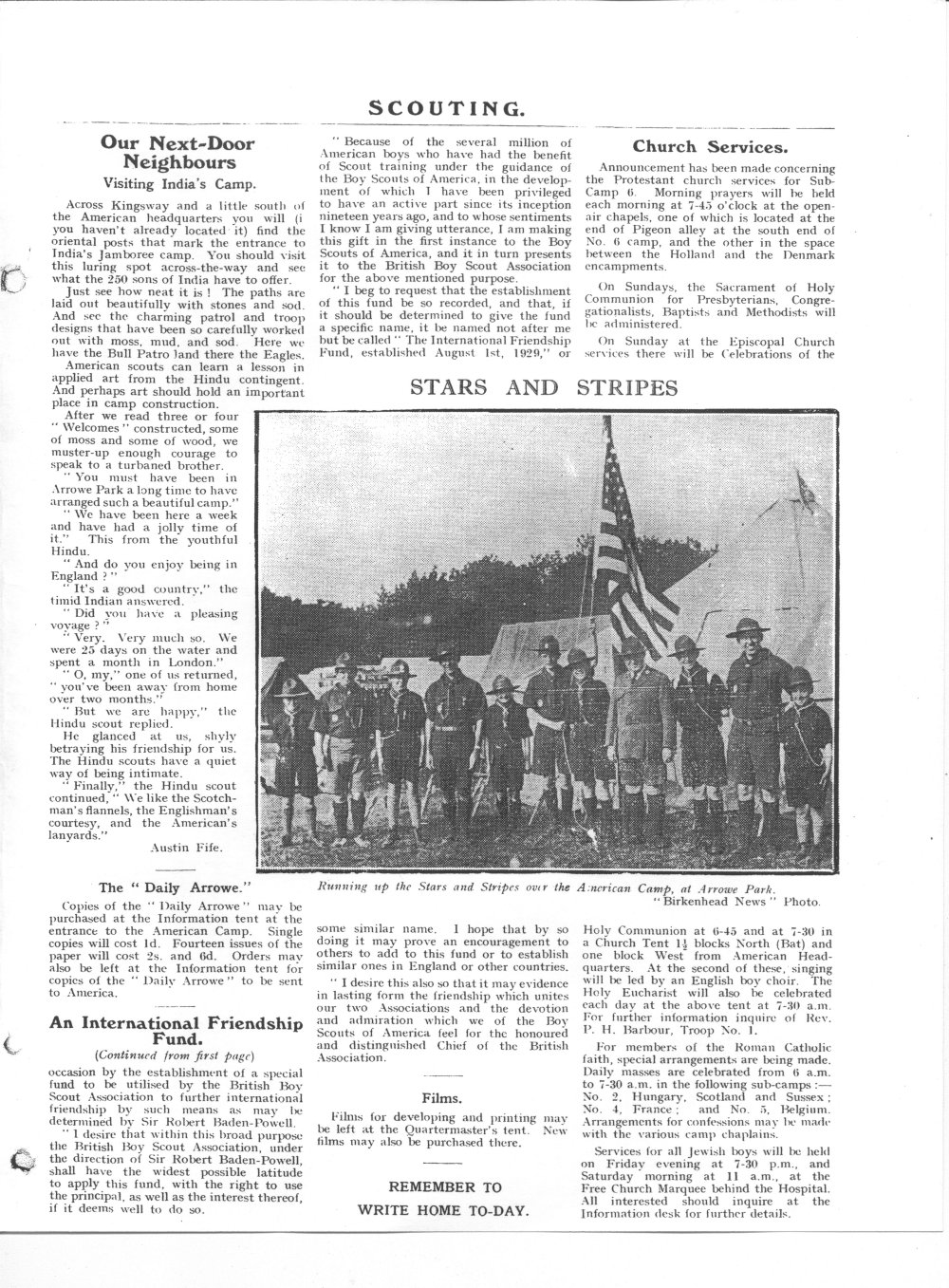
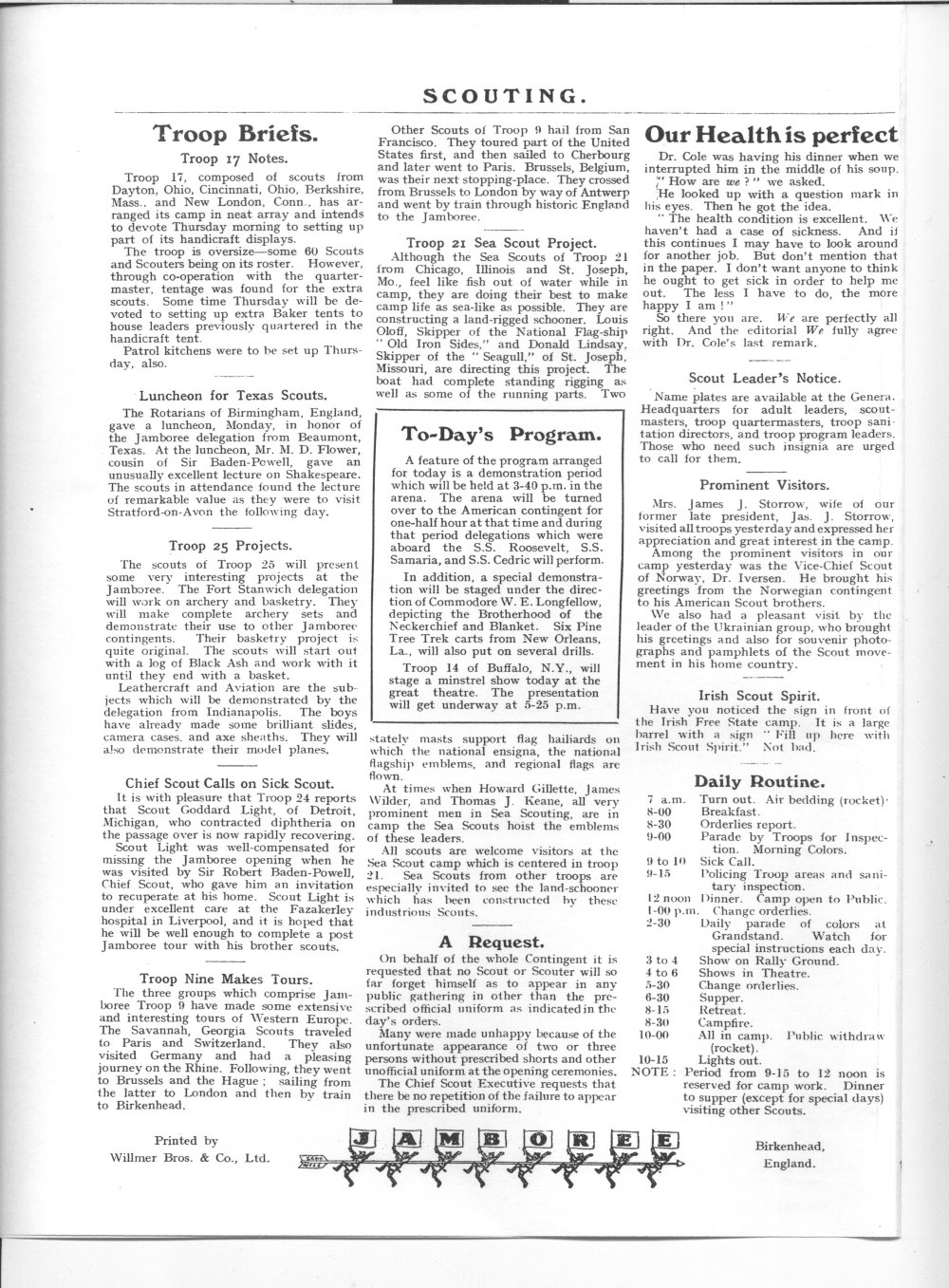
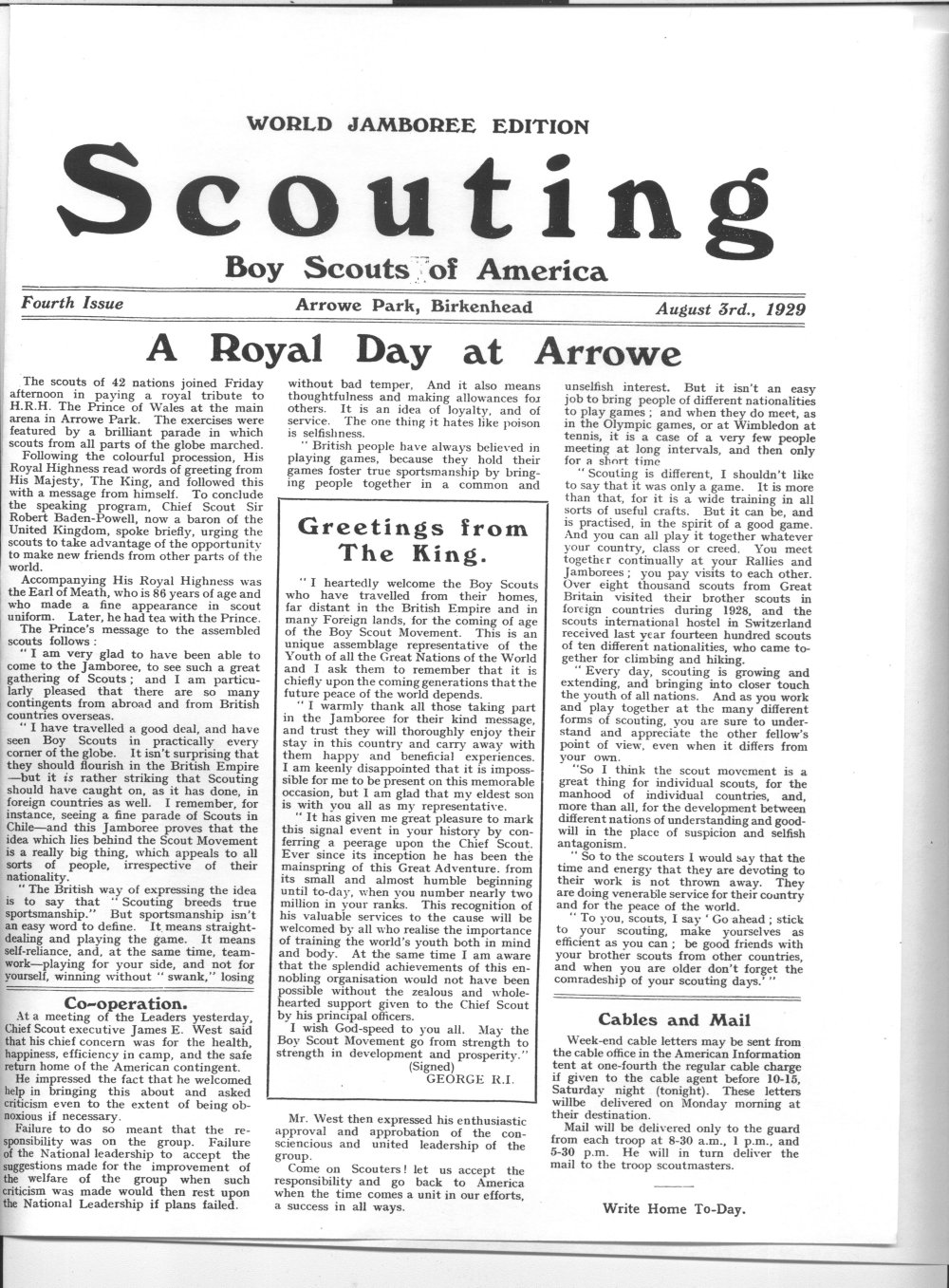
Scouting for Boys was published in six fortnightly parts, the first appearing
in January, 1908, at a cost of four-pence. The first issue of The Scout
was published on 14th April, 1908. Then the fun began! B.-P. still thought
of Scouting as an extra activity that could be done by existing clubs and
other boy organizations, but the boys themselves soon made it necessary
to begin a separate movement.
Thousands of boys bought the first part of Scouting for Boys; it was
sufficient for them that the magic initials B.-P. appeared on the cover.
But they were not content with reading about Scouting; they wanted to do
it, and if they were not members of a Brigade or Club, they got together
in little gangs, formed themselves into Patrols, and got down to practical,
out-of-doors Scouting. Then they would try to persuade some grown-up to
become Scoutmaster. In this way Scouting spread, and as the numbers of boys
rapidly grew, it was obvious that something would have to be done about
it.
Mr. Pearson again helped; he provided a one-room office as a center for
the Boy Scouts, as they were soon named. The first Manager of the office
was Major Kenneth Maclaren, and he was followed by Mr. J. A. Kyle. The movement
grew at a most astonishing rate. By the end of 1908 there were 60,000 Scouts
enrolled; there were probably many more actually going through the training,
but it took some time for all to be brought into touch with the new head
office.
The problem of uniform had to be faced very early, and B.-P. thought
out the details in his usual practical fashion. In the following note he
set down the whys and wherefores:
"I knew from experience with boys of all sorts in our first experiments
in Scouting tat one fellow got his trousers all torn and wet going through
a scrub, another wearing a small cap got his face - very nearly his eyes
- badly scratched by thorns in going through the bush at night, and the
rain ran down his neck, others got too hot in their coats and waistcoats,
another, going bareheaded, got sunstroke, and so on. So it became necessary
to suggest some kind of dress that would suit all phases of Scouting and
yet be healthy and inexpensive and comfortable. Then everybody would come
to be dressed much the same as his neighbour - in fact, in uniform. So I
thought out what would be the best patterns to adopt. Now - and here is
a useful tip for you - whenever I went on an expedition of any kind I kept
a diary and that diary included a list of the clothing and equipment I took
with me, with a note of what I need not have taken and also of what I had
omitted to take. All this information came in useful when one was going
on another expedition. Also I drew a sketch of myself showing what dress
I found to be most convenient for the job I happened to be doing. At one
time it was in India, another in South Africa, also Scotland, Canada, West
Africa, Himalayas, etc., etc.
From these data I compiled what I thought would be a dress applicable
to most countries. I had used it to some extent in dressing the South African
Constabulary when I formed the Corps, and so a good deal of the idea came
into the Boy Scout uniform when I devised that. But there was nothing military
about it. It was designed to be the most practical, cheap and comfortable
dress for camping and hiking, and in no way copied from soldier's kit."
The origin of the Scout staff - its usefulness in Ashanti - has already
been noted.
The question is sometimes asked, "Which was the first Troop?" A number
of Troops have claimed to hold that distinction, but it is impossible to
make any definite decision because some Troops had been formed long before
there was any proper system of registration. The honour of being first is
really shared by a number of pioneer Scouts who by their enthusiasm made
an organized movement necessary.
The Scout ran competitions in 1909 to select Scouts for B.-P.'s second
camp; this was held at Humshaugh in Northumberland in the August of that
year.
B.-P. had himself taken a holiday earlier in the year in South America,
and found that Scouting had already reached that part of the world. As a
result of his visit the first foreign Scout Association was formed in Chile.
In 1909 the movement gathered speed. A party of British Scouts toured
Germany - the first foreign visit of the Boy Scouts. Then came the summer
camp under B.-P. This time it was partly on land, at Buckler's Hard, Beaulier,
and partly on C.B. Fry's training ship, the Mercury. This was the beginning
of Sea Scouts as a distinct activity. B.-P.'s eldest brother, Warington,
wrote the handbook for the new section, and his expert advice was of the
greatest value.
The same year saw two rallies. At the Crystal Palace in September 10,000
boys marched past their Chief Scout, and shortly afterwards 6,000 Scotch
Boy Scouts were inspected by him at Glasgow in company with Sir William
Smith, the founder of the Boys' Brigade.
The Scout competition in 1910 was for a party of Scouts to tour Canada,
and the lucky winners crossed the Atlantic with B.-P. They were greeted
at Quebec by French-Canadian Scouts - the first Empire Scouts outside Great
Britain to meet B.-P. on their native soil.
By the end of 1910 there were over 100,000 Scouts in Great Britain; the
movement had established itself as one of the leading boys' organizations
within little more than three years of that first camp at Brownsea Island.